
White County Criminal Docket Searches
MyCase is the statewide public search for White County criminal cases. It draws public case information from Odyssey, the case-management system used by White Superior Court. Start with a cause number when possible. A party name also works, but common names can return a long statewide list. Select White County, then check that the cause number begins with the Superior Court identifier 91D01. The case number and court code matter because federal cases and cases from other Indiana counties do not belong to the White criminal docket.
MyCase shows a Chronological Case Summary, or CCS. That event history is useful for charges, hearings, orders, and disposition entries, but it is not the official record and does not guarantee an image for each filing. The White County Clerk's Office keeps the official file for White Superior Court. Have the defendant's full name, filing year, case classification, and approximate event date ready when a cause number is unknown.
- Open MyCase and choose Case or Name search. Select White County in the Court field.
- Enter the cause number without hyphens if needed, or enter the party name. Add filing dates and status to narrow a broad result.
- Confirm the 91D01 court prefix and criminal code before opening the result.
- Read the newest CCS events for charges, settings, plea, disposition, sentence, bond, and later financial activity.
- Call the Clerk at 574-583-7032 or visit the second-floor counter for a missing public item, a current ledger, or a certified copy.
White Superior Criminal Filing Hub
White County's 2026 local rules assign criminal cases to White Superior Court. The same allocation includes infractions, ordinance violations, and expungement matters. White Circuit Court handles many other case groups, but it is not the routine criminal filing court. This local split makes the cause prefix a fast accuracy check.
Quick answer: A current county criminal case should ordinarily carry White Superior's 91D01 identifier. Call Superior at 574-583-1548 about a setting and the Clerk about the official record or copy.
White Criminal Docket Source Images
Indiana's official cause-number rule supplies the court identifiers and criminal case codes used in White County.
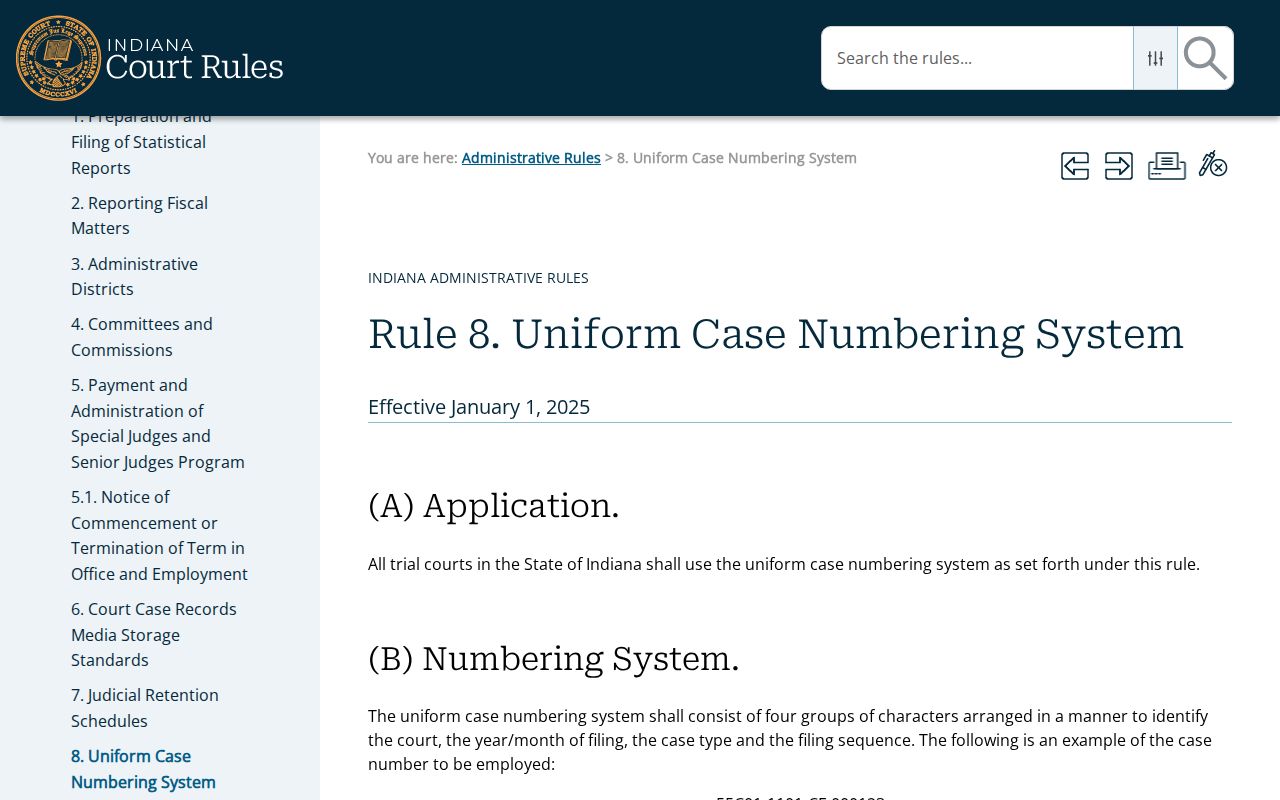
The prefix and case code help identify the file, while the CCS disposition states what happened.
Criminal Court Dockets: What They Show
A White County CCS begins with the cause number, court, judge, filing date, caption, status, and criminal classification. Party and attorney blocks identify public participants. The event list then records filings and court action in date order. Read entries as an index to what happened, not as a substitute for the signed order or filed document. An event labeled filed proves receipt, while a grant, denial, plea, conviction, dismissal, or sentence requires its own court entry.
| Cause number | A code such as 91D01-26-F6-000123 identifies county, court, filing year, case type, and sequence. |
|---|---|
| Charge | Offense, felony or misdemeanor level, and statute text or code when posted. |
| Settings | Date, time, judge, courtroom, hearing type, reset, and result when entered. |
| Events | Initial hearing, appearance, motion, discovery notice, plea, trial, order, and warrant-related activity. |
| Disposition | Dismissal, conviction, acquittal, sentence, probation, review, and later financial entries. |
White Criminal Codes in Plain Terms
Indiana Administrative Rule 8 supplies the case-type codes. They classify the file; they do not announce the outcome. A person who sees F6 should not infer a conviction, and an open status does not prove that an old hearing remains current.
- F1 through F6
- Current felony levels, with F1 the most serious numbered level.
- CM
- Criminal misdemeanor.
- MC
- Miscellaneous criminal.
- IF
- Infraction, assigned locally to Superior Court.
- MR
- Murder case classification.
Older files may use CF or FA through FD. Converted events can also mark data moved into Odyssey. In each instance, the latest CCS and the filed disposition order provide better context than the code alone.
Criminal Case Stages on the Docket
White local criminal rules describe a sequence that may include an initial hearing, pretrial conference, omnibus date, plea or trial, disposition, and sentencing. Motions, counsel appearances, discovery notices, bond action, warrants, and continuances can add events between those points. A scheduled event is not proof that it occurred. Look for the hearing result, a reset, or the next order.
Docket flow: Charge Filed › Initial Hearing › Pretrial and Omnibus Settings › Plea or Trial › Disposition › Sentencing
The newest entry controls practical planning. If a prior notice and a later CCS setting conflict, contact the White Superior Court administrator before relying on the older notice.
White Charges Without Document Images
MyCase may display a charge and CCS event without providing the charging document as a remote image. That gap does not mean the filing is absent. Indiana's case-type access table, public-record exclusions, and the document's own contents affect online viewing.
First confirm the cause number and event date. Then check MyCase document-access guidance. Ask the Clerk for the public portion of the CCS or the specific public document if it is not online. Identify whether a plain or certified copy is needed. The counter is at 110 North Main Street, second floor, Monticello, and the Clerk also publishes PO Box 350 and fax 574-583-1532. Confirm fax acceptance and payment before sending.
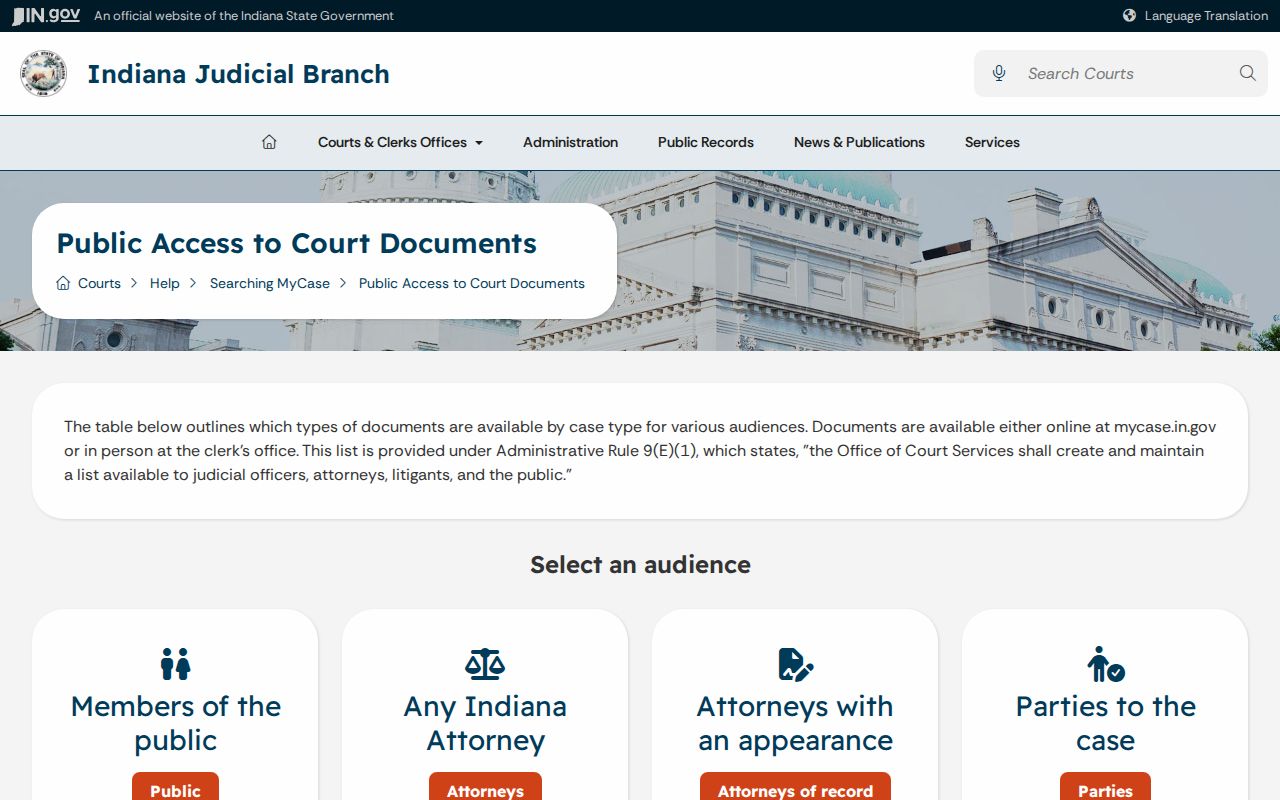
The state access table shows why a public CCS event and a downloadable image are not the same thing.
White County Criminal Docket Courts
White Superior Court receives county felony, misdemeanor, miscellaneous criminal, infraction, ordinance, and expungement filings under LR91-AR01-02. White County has no current city or town criminal court. Administrative Rule 8 lists the former White/Monon Town Court as abolished in 2011. A ticket or ordinance matter arising in Monticello, Brookston, Monon, Reynolds, or Wolcott therefore does not create a separate town docket.
Federal prosecutions are different. They do not appear in the White Superior CCS. Use PACER or the U.S. District Court for the Northern District of Indiana. The former Lafayette clerk office closed in 2024, and services moved to Hammond, so call before travel. State appeals move to the Court of Appeals of Indiana and may later reach the Indiana Supreme Court under appellate rules.
White Criminal Docket by Numbers
Indiana Court Online Reports recorded substantial White County criminal work in 2024. The figures give useful scale, but they are aggregate court statistics, not a count of cases currently set for hearing.
Search filters matter in a caseload of that size. Use White County, a filing-year range, and a case code to reduce false matches. The ICOR portal explains county trends, while MyCase locates an individual public case.
Access Rules for Criminal Court Dockets
Indiana Access to Court Records Rule 4 starts with a presumption of public access, regardless of whether inspection occurs online or at the Clerk's counter. Rule 5 excludes specific records and protected data, and Rule 6 permits extraordinary exclusion by court order. Expunged, sealed, juvenile, and other protected criminal information may be absent or limited. No MyCase result can also reflect a spelling mismatch, indexing delay, or converted data, so it does not prove that no case exists.
Key rules:
Access to Court Records Rule 4 states the general public-access rule.
Access to Court Records Rule 5 identifies excluded records and protected information.
Indiana Code 35-38-9 governs expungement, which can change public access.
For permitted inspection or copies, visit the unified White County Clerk's Office during its published weekday hours, call, or send a focused written request. Include the court, cause number, date range, and requested event. This is also the route for a sentencing order, bond order, or certified copy that MyCase does not expose.
The official excluded-records rule is the source for protected criminal material.
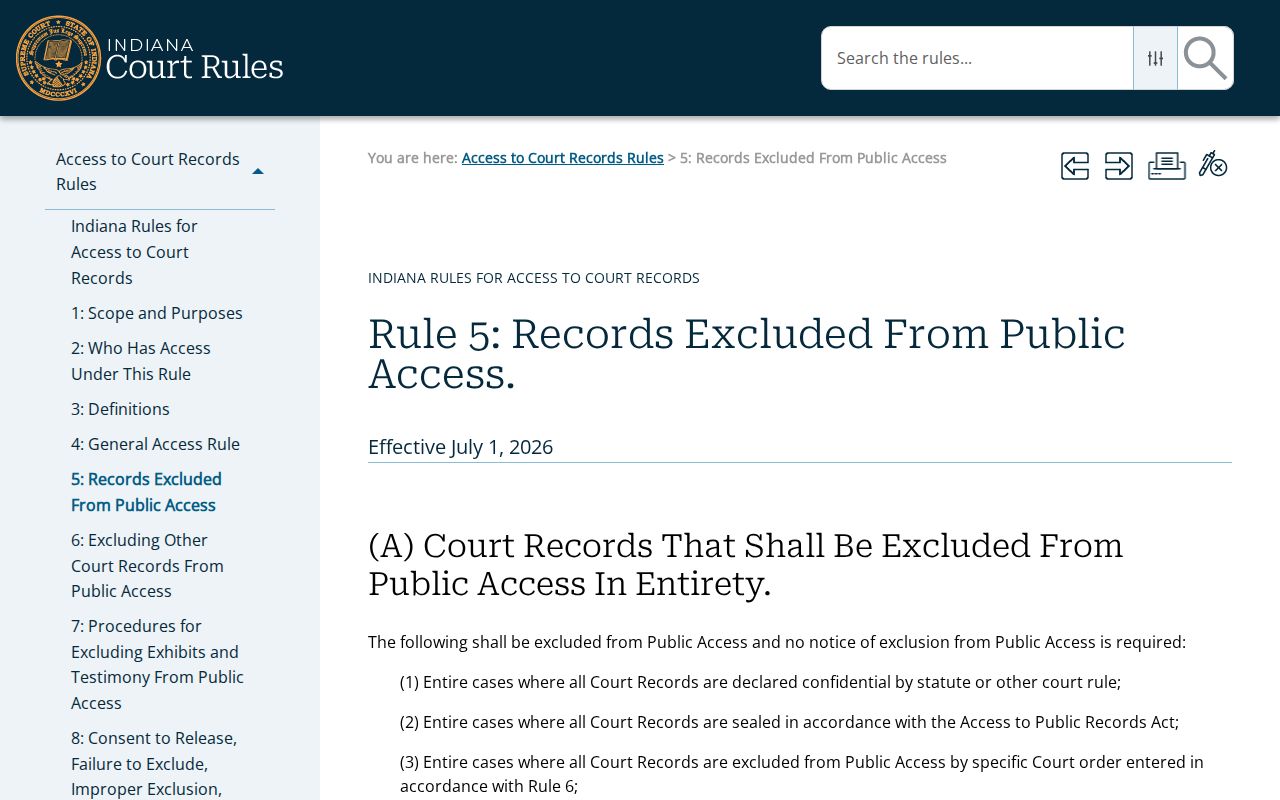
Apply the rule to the document sought, not to broad assumptions about the whole case.